iPhone Fold after two weeks — Apple's first fold, seen through a Z Fold 7 owner's eyes
Apple finally made a folding phone. I've been on a Z Fold 7 for almost a year, so I picked up the iPhone Fold with one clear question: if Apple is 7 years late, did they do it better? After two weeks — here's what Apple got right, what they got wrong, and why the software is the real story.
Apple is 7 years late. Samsung shipped the first Galaxy Fold in 2019; it’s 2026 and they’re on generation seven. I’ve been on a Z Fold 7 for almost a year and I’m fairly hooked on the fold form factor. So when the iPhone Fold launched, my question wasn’t “are folds any good” — I already know they are — it was: if Apple is 7 years late, did they actually do it better than the people who went first?
I borrowed one from a friend who runs an Apple reseller and used it as a secondary phone for two weeks (second SIM, not my daily driver — my daily is still the Pixel 9a). This isn’t an unboxing video. It’s two real weeks, folded into my freelance workflow.
TL;DR
Buy if:
- You’re deep in the Apple ecosystem (Mac + iPad + Watch) and want a fold that “just works” with them
- You value hardware finish over software features
- You’ve never used a fold and want your first to be the lowest-risk one
Don’t buy if:
- You’ve used a Z Fold and you’re used to Android-style multitasking — the iPhone Fold will feel boxed in
- You hate first-gen Apple (and you should — Apple always saves features for gen 2)
- The $2,299 price makes you flinch (it should)
Hardware in brief
- 7.8” inner OLED at 120Hz, 5.5” cover display — a more usable cover ratio than the Z Fold (Samsung’s is too tall and narrow).
- Titanium frame, new “liquid metal” hinge — Apple claims 500,000 folds.
- A19 Pro, 12GB RAM.
- Cameras borrowed from the iPhone 17 Pro (48MP main + ultrawide), no telephoto — cut to fit the thin body.
- 238g, 9.2mm folded — a touch thinner than the Z Fold 7.
- Touch ID in the power button (not Face ID — no room for TrueDepth in a thin hinge).
- Starts at $2,299.
3 things Apple got right
1. The crease — nearly gone
This is where “7 years late” pays off. The crease on the iPhone Fold is markedly fainter than the Z Fold 7. Swipe a finger across the middle and you barely feel the channel. The Z Fold 7 still has a shallow groove your eye catches on a bright white background.
Apple waited until the hinge tech matured before jumping in. That’s their classic play: don’t be first, be right. For folds, “right” means the crease everyone has hated for 7 years is finally faint enough to forget.
2. The hinge — the best mechanical feel I’ve held
The Z Fold 7 hinge is good. The iPhone Fold hinge is better. It holds at any angle (like the Z Fold) but the damping is smoother — it opens like a German car door, no plasticky click. This is the thing Apple is great at: the physical feel of an object in your hand.
After two weeks and a few hundred open-close cycles, no creaking, no play. My Z Fold 7 has developed a little hinge wobble after 10 months. The iPhone Fold is too new to judge long-term — but the initial feel is more solid.
3. Tablet apps — iPad paved the road for 14 years
This is Apple’s unfair advantage. Android tablet apps have been a wasteland for 14 years — most apps are just blown-up phone versions. Open an app on the Z Fold 7’s big screen and half of them look like a fuzzy upscale.
The iPhone Fold runs iPad apps. 14 years of iOS devs have optimized for the big canvas. Open Things, Notion, Lightroom, Procreate on the inner display — they’re all real tablet layouts, not stretched phone apps. Here “late” turns out to mean “arriving with 14 years of luggage.”
2 things Apple got wrong (all first-gen)
1. iOS still doesn’t know it’s running on a fold
This is the biggest problem. The hardware is a fold; the software still thinks it’s a big iPhone.
- Open an app on the cover screen, then unfold → app continuity is fine. But the reverse (you’re on the inner screen, you fold it shut) → some apps reload and lose state.
- No proper iPad-style split view. You’d think a 7.8” inner display would run two apps side by side like an iPad? It does, but more restricted than the iPad — Stage Manager is cut down, drag-and-drop is limited. The Z Fold 7 runs 3 apps + a floating window; the iPhone Fold does 2 apps, less flexibly.
- Some third-party apps (including big ones) haven’t updated their fold layouts and show with black bars on either side when unfolded.
Apple is selling 2026 hardware with a 2022 software mindset. This is exactly why I say “don’t buy first-gen.”
2. No telephoto — and it stings
The cameras are borrowed from the iPhone 17 Pro but drop the telephoto. On a $2,299 device, no optical zoom is a hard cut to swallow. The Z Fold 7 has a 3x tele. My $500 Pixel 9a doesn’t have a tele either — but the Pixel 9a is a $500 phone, not a $2,299 one.
Using it as a dev’s phone
The part I care about most: does a fold make me work better on the go?
- SSH + terminal: I use Blink Shell. On the 7.8” inner screen, a full terminal session plus the on-screen keyboard is comfortable for reading logs. Far better than a normal phone, but still narrower per line than an iPad mini.
- Reading PRs / reviewing code: GitHub mobile + the inner screen = readable diffs. This is the use case where folds win outright — hold it vertical to read a file, open it wide for a two-column diff.
- Answering Slack/mail between meetings: fold it shut and use the cover screen like a normal phone, no need to open it. The iPhone Fold’s 5.5” cover is wide enough to type on — this is where it beats the Z Fold 7 (Samsung’s cover is narrow and awkward to type on).
- Hotspot + main machine: like any phone.
Dev verdict: a fold is still the best form factor for someone who works mobile — but the iPhone Fold trails the Z Fold 7 on multitasking, precisely because iOS is more locked down than Android when it comes to running multiple windows.
Vs Z Fold 7 — the short version
I wrote a full comparison separately. Short version:
- Hardware: iPhone Fold wins (fainter crease, more solid hinge, better tablet apps).
- Software/multitasking: Z Fold 7 wins (Android allows more windows, more freedom).
- Camera: Z Fold 7 wins (it has a telephoto).
- Ecosystem: a tie — depends whether you’re already on Apple or Android.
Verdict
The iPhone Fold is the best gen-1 fold that has ever existed — because Apple let everyone else do gens 1–7 before walking in. The hardware is excellent. But the software is still iOS-on-a-big-iPhone, not a true iOS-for-folds yet.
If you’re in the Apple ecosystem and you’ve been waiting for a fold with “no hardware downsides” — this is it. If you’re used to the freedom of a Z Fold, the iPhone Fold will feel like a beautiful car with a software speed limiter.
I won’t trade my Z Fold 7 for it. But I’ll be watching the iPhone Fold gen 2 very closely — that’s usually when Apple unlocks the features it hid in gen 1.
Sources
- iPhone Fold spec from the Apple site. Tested unit: 256GB.
- Hinge and crease comparison: subjective side-by-side measurement against my personal Galaxy Z Fold 7 (bought July 2025).
- iPad app ecosystem: personal experience with Things, Notion, Lightroom, Procreate on the inner display.
- Blink Shell terminal on iOS: blink.sh.
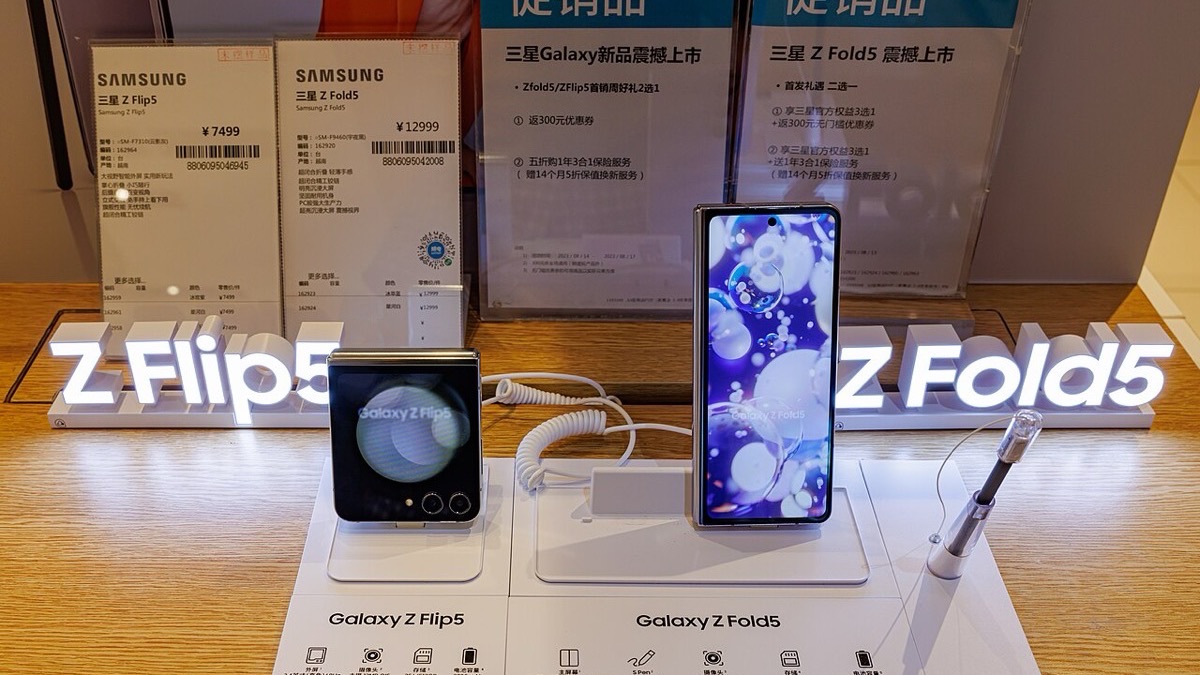
- Illustration: a folding phone, Wikimedia Commons, Samsung Galaxy Z Flip 5 & Galaxy Z Fold 5 by Dinkun Chen, CC BY-SA 4.0 (a stand-in for the foldable form factor — no iPhone Fold press image is freely licensed).
