Frieren season 2 — even as a manga reader, Madhouse keeps catching me off-guard
I've read Sōsō no Frieren through chapter 130. I know every plot beat. I still haven't skipped an episode of season 2. Here are 3 things Madhouse does better than the manga — and why Frieren is the counter-example to my JJK / Chainsaw Man worries.
I wrote two recent anime posts and they both shared one feeling: worry. Worry MAPPA will cut animation on Chainsaw Man part 2. Worry they won’t have time to do Higuruma vs Sukuna at manga quality. Classic manga reader anxiety: “I know this arc is great, I don’t trust the studio to land it”.
Frieren is the counter-example.
I’ve read Sōsō no Frieren (葬送のフリーレン) through chapter 130. I know every plot beat, who dies when, exactly how Aura is forced to end her own life. I still didn’t skip an episode of season 1, waited for season 2 from April 2025, and now — into the early episodes of season 2 — Madhouse keeps catching me off-guard week after week.
Here are 3 things I think Madhouse does better than the manga. And why this is rare in the industry.
Thing 1: Pacing
Yamada Kanehito’s manga has a signature: long silent panels. A scene of Frieren standing at Himmel’s grave, no dialogue, 3-4 panels. A scene of Fern drinking tea, looking out the window, 2 empty panels.
Reading the manga, my eye sweeps past those panels in half a second. I know it’s a silent moment — but my brain processes it as still images. The human mind needs real time to feel what isn’t said.
Madhouse gets this. In the anime, the “Frieren at Himmel’s grave” panel is stretched to 18 seconds. Camera holds still, wind moves Frieren’s hair. No music, no dialogue. 18 seconds sounds short reading this — but inside the 22-minute rhythm of an anime episode, 18 seconds of stillness is eternity. You sit there, forced to feel.
Manga points out that the moment is silent. Anime makes you live in the silence.
JJK / Chainsaw Man don’t have many of these moments. They’re action manga — still panels are beats between action. Frieren is a still panel — and Madhouse is the only studio I know that understands how to animate stillness more beautifully than draw it.
Thing 2: Voice direction — Frieren deadpan + warm Himmel flashbacks
Sound director Yamashita Daisuke cast Tanezaki Atsumi as Frieren — a decision the manga itself can never communicate.
Frieren is a 1000-year-old elf. Yamada draws her with an almost-fixed expression: half-bored, half-sad, half-uninterested. Reading visually, you fill in Frieren’s tone with imagination — and mine used to default to “cold, cynical, sardonic”.
Tanezaki goes the other way. Her Frieren isn’t cold — she’s light. Like every line passes through 1000 years before reaching her mouth. Not cynical, just she’s seen too much. When Frieren says “I don’t think this matters” — Tanezaki makes it sound like an observation, not a dismissal.
Counter to that, Himmel in flashbacks gets voiced by Okamoto Nobuhiko two tones warmer than anyone else in the show. Each time a flashback hits — Himmel’s tone shifts the room. It’s a directorial choice you cannot perceive reading the manga.
Manga gives you the dialogue. Anime gives you the dialogue and the speaker. With Frieren, the speaker is 60% of the story.
Thing 3: Aura battle — choreography exceeds the manga
This one I didn’t see coming. I’d read the Frieren vs Aura the Guillotine fight in the manga at least 4 times. I knew every panel.
When Madhouse animated it (episode 25, season 1), I watched live and texted three friends that night: “This is better than the manga”.
Manga: Aura casts the “kill yourself” command — Frieren doesn’t die — Aura realises her mana lost the count — she’s forced to obey her own command. Beautiful. Logical. Climactic.
Anime: 90 extra seconds of buildup not in the manga. Camera slow-zooms on Aura’s face as she realises she misjudged her opponent’s mana — her expression cycles through 5 states in 4 seconds: confident → doubt → panic → acceptance → bitter smile. Voice actor Kayano Ai inhabits all 4 seconds. Evan Call’s score (yes, the same Evan Call from Violet Evergarden) shifts from a victory tone to a requiem in half a beat.
A manga panel can hold two consecutive expressions — anime gives 5 expressions in motion in the same seconds you spend looking at one panel.
That was the moment I realised: anime adaptation isn’t always “manga panels animated”. Sometimes anime adds what manga has no vocabulary for.
Why Frieren ≠ JJK / Chainsaw Man?

I wrote two posts worried about MAPPA. Frieren is the counter-case. The differences are in 3 places:
1. Source material velocity vs anime production speed.
JJK: manga ended, anime chasing. MAPPA forcing schedule to adapt 270 chapters in < 4 cours. Cutting or quality drop is mathematical certainty.
Chainsaw Man: manga still running part 2, anime only at part 1. MAPPA has 3-4 years per season. But they lost Nakayama (part 1 director) to creative disagreement, and the studio’s current pipeline is overloaded with JJK + Bleach + Vinland Saga.
Frieren: manga around chapter 140, anime adapted ~60 (season 2 expected to land near ~95). Madhouse has a 50-chapter buffer. Source stable, schedule unhurried.
2. Genre fit with studio strength.
MAPPA is strongest at set-piece action choreography (Demon Slayer-tier when they want). They’re weaker on dialogue and inner monologue — that’s not their bread and butter.
JJK is 70% set-piece — fit. But the final 30% of JJK is Yuji / Megumi inner monologue — that’s the 30% MAPPA struggles with.
Frieren is 70% dialogue + inner monologue + still scenes — perfect fit for Madhouse, the studio behind Hunter x Hunter (2011), One Punch Man season 1, Death Note. They know how to animate two people talking better than swords clashing.
3. Director-led vs committee-led.
Frieren seasons 1+2 directed by Saito Keiichirō — single director, consistent vision. JJK season 2 swapped directors mid-cour. Chainsaw Man lost Nakayama. Frieren has none of that drama.
When manga readers should watch anime — and when not
After 15 years of reading manga and watching adaptations, here’s what I’ve settled on:
Watch the anime if:
- The studio is strong in the genre (Madhouse for slice-of-life / drama, Wit for clean action, Bones for fight choreography, Ufotable for effects-heavy)
- Source material is stable and production schedule has runway
- Manga has lots of stillness / dialogue / small expressions — animation and voice acting will add depth
- Music is handled by an A-tier composer (Sawano, Hiroyuki, Evan Call, Yuki Kajiura)
Manage expectations if:
- Studio running 4 series simultaneously
- Manga ended and anime racing to catch up
- Action manga with extremely complex choreography (animation cuts or lazy CGI risk)
- Director changes mid-season
Frieren ticks all the first boxes. Chainsaw Man part 2 and final-arc JJK tick many in the second list. That’s why I wrote two worried posts and one confident one.
Closing
The first time I watched Frieren season 1, I was going to “skip it because I know the plot” — just watch 1 episode for reference. I watched all 28, then re-read manga vol 1-7 with Tanezaki’s voice in my head for every Frieren line.
That’s the final test for a great adaptation: it changes how you read the manga afterward. Frieren did that to me.
Season 2 is holding form. No rush, no cuts — Madhouse still gives every scene room to breathe. The Macht arc (around manga chapter 80) will be the next test — it’s the longest, most dialogue-heavy arc, and it will expose the studio if they cut corners. I’ll bet 80/20 it lands.
If you’re a manga reader on the fence: watch it. This is one of the rare cases where anime doesn’t “lose” to the manga — and in a few scenes, surpasses it.
Next time someone says “manga is always better than anime” — point at Frieren episode 25, the Aura battle. That’s enough.
Sources
- Sōsō no Frieren (葬送のフリーレン), story by Yamada Kanehito, art by Abe Tsukasa, serialized in Weekly Shōnen Sunday since 2020. English release by VIZ Media (Simon & Schuster page).
- Anime adaptation by Madhouse, directed by Saito Keiichirō, sound direction by Yamashita Daisuke, music by Evan Call. Season 1: 2023–2024. Season 2: 2025–2026.
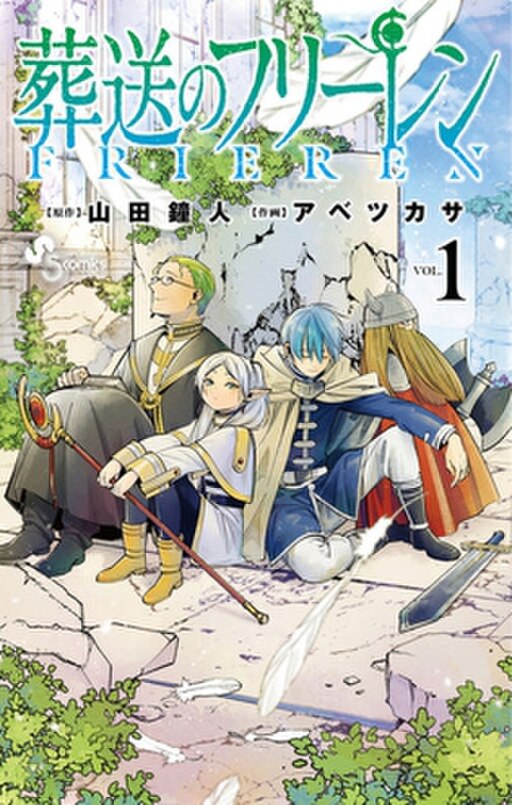
- Tankōbon volume 1 cover image from the Frieren Wikipedia article.